
Frugivory and temperature-regulated behaviour in the Knysna dwarf chameleon
South African scientists have conducted an observational study into the behaviour of the Knysna dwarf chameleon (Bradypodion damaranum). The study was carried out in a park in George, in the Western Cape province. The park is mainly used by walkers, cyclists and dog owners for recreational purposes, meaning that the chameleons there are, to a certain extent, accustomed to people.
Six adult Bradypodion damaranum were found in the evening by torchlight and fitted with transmitters. The transmitters were attached to their flanks using tissue adhesive. During the day, one chameleon at a time was observed by a researcher for up to 4.5 hours, including those without transmitters. The chameleons fitted with transmitters were then located and the transmitters removed.
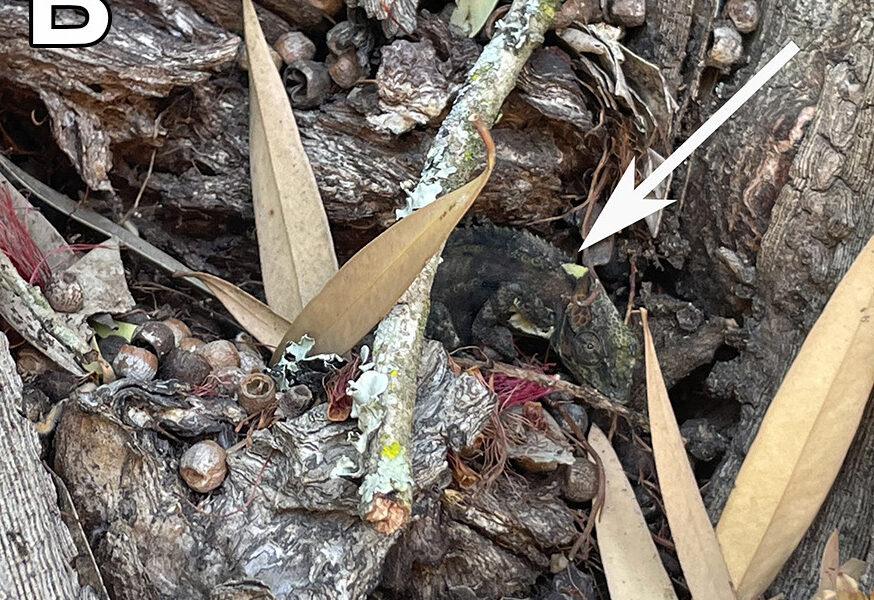
A total of 30 chameleons were observed, six of which were tagged and 24 untagged. As temperatures rose, peaking between 36 and 40°C around midday, a total of six Bradypodion damaranum were observed quickly retreating to shadier, lower-lying areas of the vegetation. Most of them turned noticeably paler than before. On another day, temperatures at sunrise were only 8°C. Several chameleons were observed moving very slowly towards sunny spots. Two were observed feeding at 12°C.
In addition, two Bradypodion damaranum were observed feeding on ripe berries from fruit bushes (Halleria lucida). Frugivory had not previously been recorded in this species. Another chameleon was observed consuming the flower of a Clutia pulchella. Overall, however, this appears to be a rare occurrence, as it was observed only a few times during 142 hours of observation.
Natural history observation of the Knsysna Dwarf Chameleon, Bradypodion damaranum (Boulenger, 1887): thermal extremes and feeding on flora
Krystal A. Tolley, Jody M. Barends, Wade K. Stanton-Jones, Graham J. Alexander
Herpetology Notes 19, 2026: 219-228.
DOI: not available
Free article download
Photo: A Bradypodion damaranum that has sought refuge from the rising temperatures on the trunk of a carmine-red bottlebrush (Callistemon citrinus), from the publication mentioned
Beobachtungen Science