
Avian predators of the Indian Chameleon

Avian predators of the Indian Chameleon

Beobachtungen Science

This week, a review paper was published in which an Indian biologist summarizes a series of observations in which birds have attacked chameleons in Sri Lanka and India. These are exclusively observations with Chamaeleo zeylanicus, the Indian chameleon, as prey.

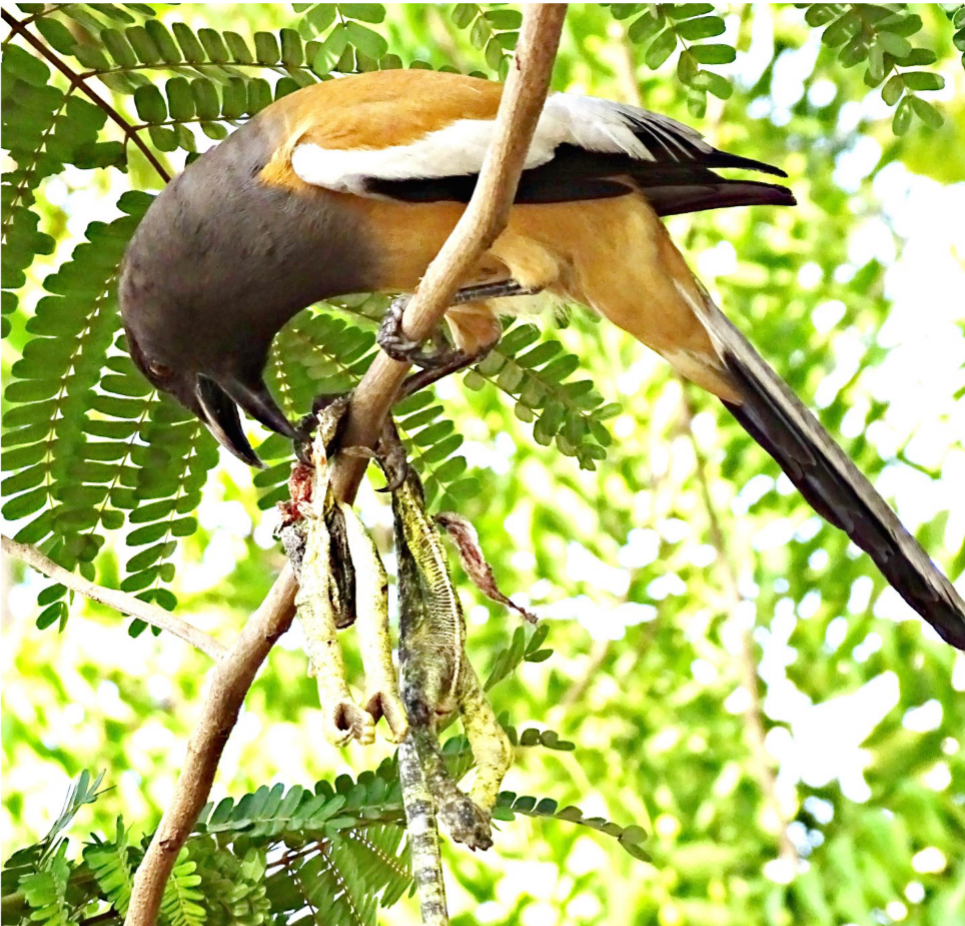
A total of seven birds have already been observed either attacking or eating Chamaeleo zeylanicus between 2012 and 2023. In Bhadreshwar on the western edge of India, a greater coucal (Centropus sinensis) was observed preying on a chameleon. In the Janbughoda Wildlife Sanctuary in eastern India, it was a rufous treepie (Dendrocitta vagabunda) that flew away with a chameleon in its beak and was then photographed eating it. In the Kolli Hills in southern India, a crested serpent eagle (Spilornis cheela) was observed eating an Indian chameleon. Three other crested serpent eagles were seen hunting in Wilpattu National Park in Sri Lanka. Another observation in the same national park shows the Malabar pied hornbill (Anthracoceros coronatus) as a predator of chameleons.

Avian predators of the Indian Chameleon Chamaeleo zeylanicus
Raju Vyas
Biodiversity Observations 15, 2025: 96-98
DOI: 10.15641/bo.152

Photo: Rufous treepie eating an Indian chameleon, the photo was taken from the open source publication mentioned above
Eagle owl captures chameleon

Eagle owl captures chameleon

Beobachtungen Science

The eagle owl (Bubo bubo) is the largest native owl in Europe and has a large range that extends as far as Greece. It is not only very adaptable in terms of the habitat it uses, but also in terms of its prey. Known and common prey in the Mediterranean region include small to medium-sized mammals and other smaller birds. Ampihibians, reptiles, fish and invertebrates such as insects are also preyed upon, but have always been considered more of a stopgap, especially in areas of Greece where there is a lack of larger prey.

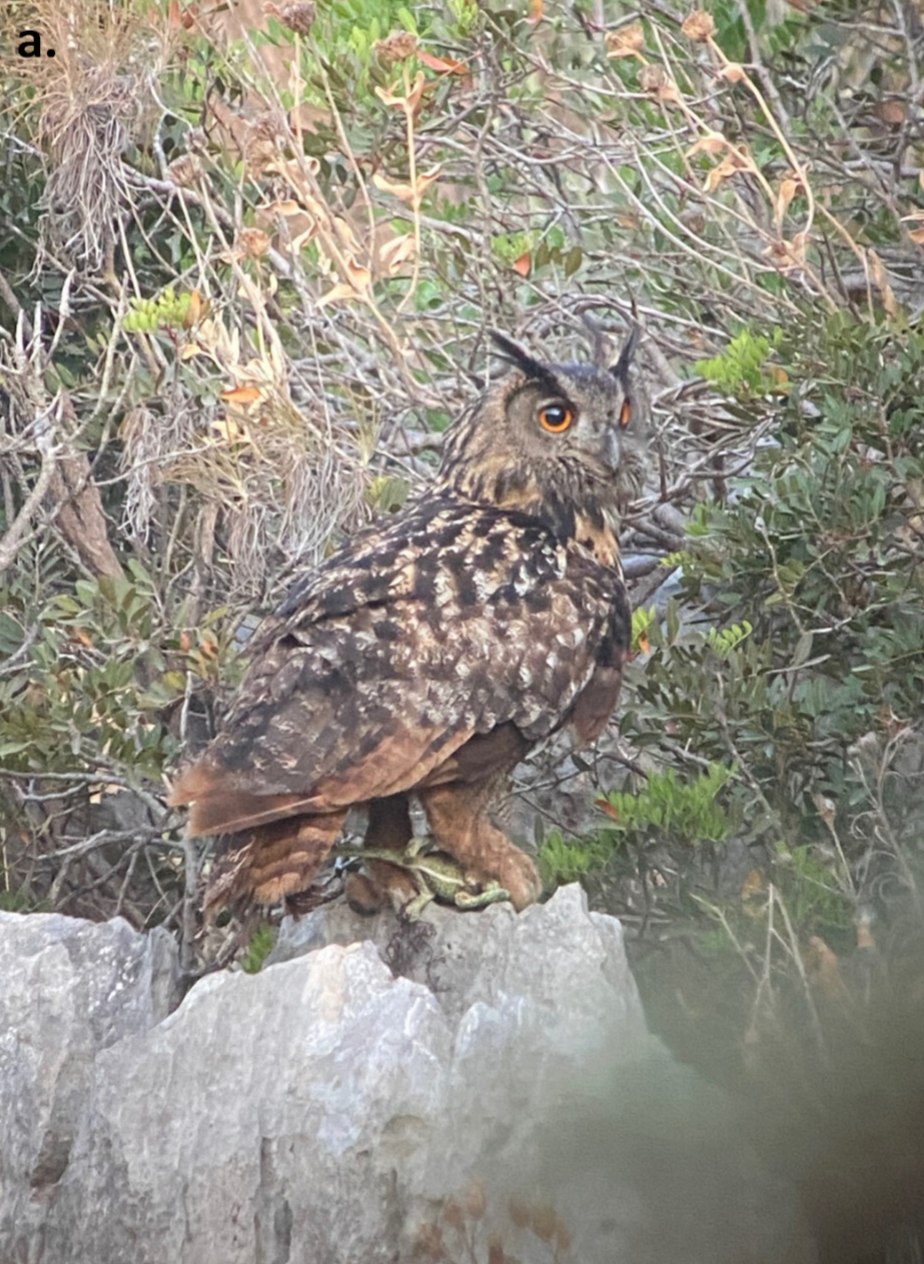
Greek authors recently made a very special observation on the prey spectrum of the owl species in the area around Pylos in the western Peloponnese. In July 2024, the authors observed an eagle owl hunting in the early morning. To their surprise, it preyed on a Chamaeleo africanus. This is the first published observation of an eagle owl preying on a chameleon. Further research on this would be desirable, as there is a general lack of data on the prey spectrum of eagle owls in the Peloponnese.

An exceptionally rare predation on a chameleon species (Squamata: Chamaeleonidae) by a Eurasian Eagle-Owl (Aves: Strigidae)
Apostolos Christopoulos, Luca Cornacchia, Christos Kotselis, Yiannis G. Zevgolis
Diversity 17, 2025: 333
DOI: 10.3390/d17050333

Photo: from the publication mentioned

Madagascar giant chameleon eats carpet chameleon

Madagascar giant chameleon eats carpet chameleon

Beobachtungen Science

Three authors report an interesting observation from the capital of Madagascar, Antananarivo. Near Akamasoa, they observed a male Furcifer oustaleti in the process of devouring another chameleon. The animal had not been observed hunting. The victim, presumably a carpet chameleon (Furcifer lateralis), was completely devoured within a few minutes.

The observation is one of a few exciting sightings of relatively large chameleons that at first glance appear to eat ‘too large’ prey. However, this does not seem to happen very often, as the few existing observations are spread over several decades. It is interesting that the new observation was made in the dry season, when the insect density is significantly lower compared to the rainy season.

Predation on Furcifer sp. by Oustalet’s Chameleon, Furcifer oustaleti (Mocquard, 1894), in the Central Highlands of Madagascar
Angelinah René de Roland, Duvivier Razarazafy, Séraphin Fabrice
Herpetology Notes 18: 305-306.
DOI: not available

Photo: from the publication mentioned

Furcifer verrucosus discovered in the stomach of a snake

Furcifer verrucosus discovered in the stomach of a snake

Beobachtungen Science

Biologists from the University of Michigan (USA) recently made a curious discovery: they analysed a snake of the species Langaha madagascariensis that had been prepared 31 years ago using dissection and microCT. The specimen had been largely untouched in the Zoological Museum of the University of Michigan since 1994. The snake was originally collected by R.A. Nussbaum in the extreme south of Madagascar, not far from Tolagnaro. Little is known about the diet of the leaf-nosed snake, only anecdotal case reports are known. Chameleons have now been added to the list of potential prey: An adult Furcifer verrucosus was found in the stomach of the female leaf-nosed snake examined.

Natural history notes: Langaha madagascariensis (Malagasy leaf-nosed snake)
Andressa L. Viol, Hayley L. Crowell, Justin L. Lee, Tristan D. Schramer
Herpetological Review 55 (2), 2025: 223-226.
DOI: not available

Photo: Furcifer verrucosus, photographed by Nick Newberry, CC BY 4.0