
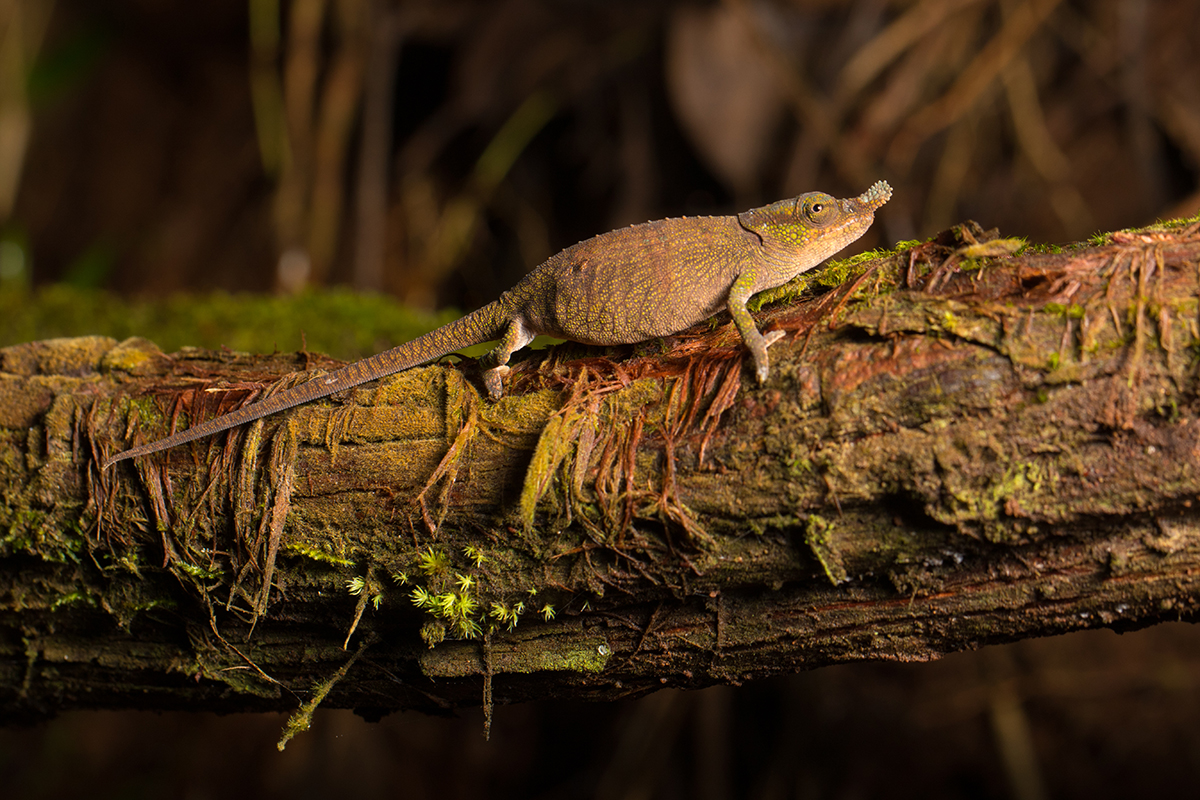
Keeping and breeding Calumma linotum

Keeping and breeding Calumma linotum

Haltungsberichte

The keeping and breeding of small chameleons of the genus Calumma has so far, apparently, only found enthusiasts on a rather small scale. So it is all the nicer that a new report on the keeping and especially the successful breeding of Calumma linotum has just been published. Michael Nash from the USA has been keeping the species for over three years and gives a detailed account of his experiences.

He keeps his animals in the terrariums commonly used over here with a completely ventilated lid and either vents in the front bottom or the entire front as ventilation, living plants, and living substrate. T5 tubes with and without UV-B are used for lighting. For food he uses fruit flies (Drosophila spp.) to a good 50%, and otherwise among other things small crickets, house crickets, blowflies, and mantid nymphs.

The best breeding successes are achieved by keeping them individually and putting them together for a few days to mate during the imitation rainy season. To induce mating behaviour, dry and rainy seasons are imitated. The dry season is mainly characterised by a massive night-time drop in temperature to 10°C and less irrigation. During the imitated rainy season, temperatures rise to around 26°C during the day and 18-21°C at night, and there is also increased irrigation during the day.

The females lay 2-3 eggs after an average of 22 to 40 days of gestation. So far, it has been noticed that mated females of the species are capable of fertilisation for an unusually long time, namely up to five clutches. The eggs are first incubated at 16 to 21°C for two to four weeks. This is followed by a diapause of 30 to 45 days at 10 to 15°C. The eggs then lie in daytime conditions. Afterwards, the eggs lie at 22°C during the day and between 16.7 and 19.5°C at night. If the eggs do not show any embryonic and vascular development during shearing after the diapause, it is possible to imitate a second diapause – at the latest, after this, the first egg development should be visible. After 5 to 7 months, active young hatched under these incubation conditions. The author has successfully hatched eleven clutches so far.

All in all, a very readable husbandry report, which hopefully supports other keepers in breeding and long-term conservation of this interesting, small species in the terrarium.

Keeping and breeding Calumma linotum
Michael Nash
Responsible Herpetoculture Journal 7, 2023
keine DOI vorhanden
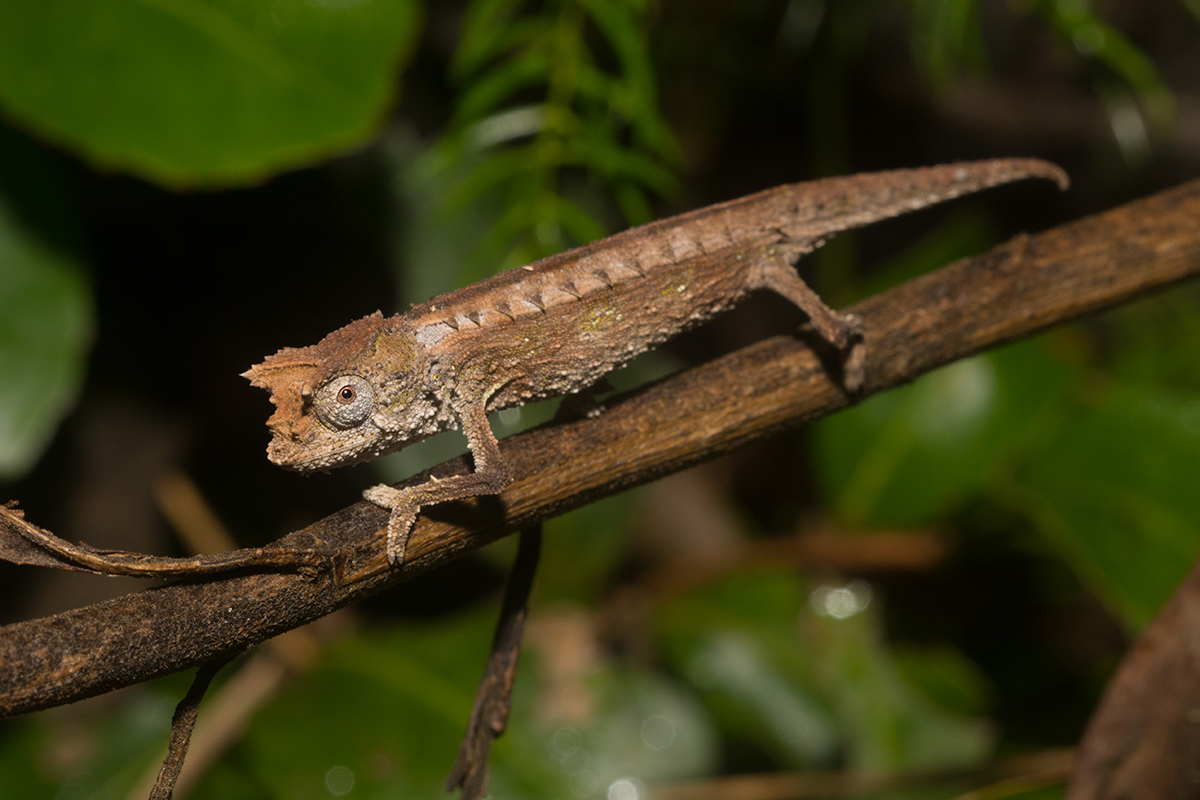

Keeping and breeding Brookesia thieli

Keeping and breeding Brookesia thieli

Haltungsberichte

The breeding of leaf chameleons outside Madagascar has been successful since the 1990s. Nevertheless, there are only a few keepers who can prove breeding success in the long term or who have been dealing with individual leaf chameleon species for years. Michael Nash from the USA has now published a detailed husbandry and breeding report on Brookesia thieli.

He keeps his animals in the terrariums we commonly use with completely ventilated lids and either vent in the front bottom or the entire front as ventilation area, living plants, and bioactive substrate. T5 HO and halogen spotlights are used for lighting. The best breeding results were achieved by keeping two or three males together with four females. The author was able to make exciting observations on the defensive behaviour of males, where the animals not only open their mouths but actually protrude their mouth cavities. For food, the author uses Zelus renardii, a type of predatory beetle from North America, in addition to the usual small food such as micro crickets, bean beetles, and various flies. This is sold as a beneficial insect and is used, for example, in the Mediterranean region to control certain pests in olive plantations. In addition, Brookesia thieli particularly liked winged termites offered by the author, which might also be an interesting food animal that has hardly been used by chameleon keepers so far.

To trigger mating behaviour, dry and rainy seasons are imitated. The dry season is characterised above all by a massive night-time drop in temperature to 13°C and less irrigation. During the imitated rainy season, temperatures rise to around 26°C during the day and 19-21°C at night, and there is also increased irrigation during the day. Females lay 3-5 eggs after an average gestation of 30-60 days, with up to three clutches per female per season. The best incubation success was achieved at 21-23°C during the day and 19-20°C at night. The author notes that hatching rates increased after supplementing the diet with preformed vitamin A every two months.

Overall, this is a very readable husbandry report with many interesting details. Hopefully that the data will support keepers in the breeding and long-term conservation of this exciting leaf chameleon species.

Keeping and breeding Brookesia thieli
Michael Nash
Responsible Herpetoculture Journal 5, 2022
keine DOI vorhanden