
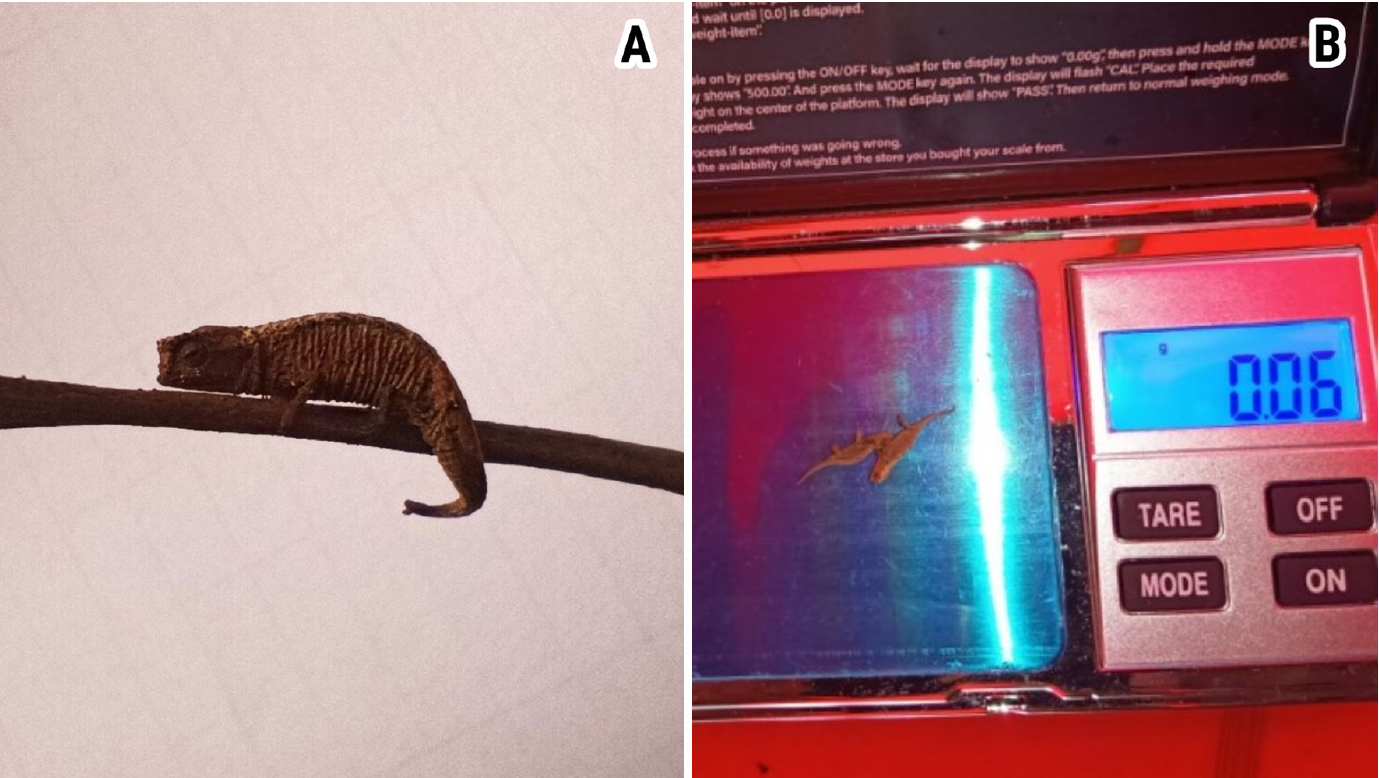
The world’s smallest known chameleon was discovered a few years ago in Sorata, in northern Madagascar. The Sorata Forest forms part of the Marojejy-Anjanaharibe-South Tsaratanana corridor (COMATSA), an area of fragmented forest remnants situated between the major national parks mentioned and the Réserve Naturelle Intégrale. It is currently managed by the WWF in collaboration with a local organisation called Ambodimandresy Miaro ny Ala.
Scientists from the universities of Antsiranana and Antananarivo have now investigated the abundance of Brookesia nana in Sorata. For 14 nights during the rainy season, they searched for the tiny chameleons along 14 transects, each 150 metres long.
In total, the scientists found 0.33 individuals per 100 m. In concrete terms, this means that only seven Brookesia nana were found across the 2,100 m of transects. The females were slightly larger than the males. All the chameleons were found sleeping on very low vegetation, on average just 7 cm above the ground.
The low abundance necessitates further studies in other forests of the COMATSA corridor to determine the exact distribution of Brookesia nana. It is also interesting to note that Brookesia nana appears to be rarer than other species of the minima group, suggesting that the species may be at greater risk of extinction.
A brief overview of the natural history of the recently described, miniaturised leaf chameleon, Brookesia nana Glaw et al., 2021, from Sorata Forest, northeastern Madagascar
Jeanneney Rabearivony, Andriatsitohaina Ranaivojaona, Asmeralie Willian, Crispin Jaohasy, Moussaïna Jao, Achille P. Raselimanana
Herpetology Notes 19, 2026: 123-128.
DOI: not available
Free article download
Photo: Brookesia nana, found in the study mentioned, photographed by Asmeralie William