Presentation in Dortmund about Kenya

Presentation in Dortmund about Kenya

Reiseberichte Live lectures

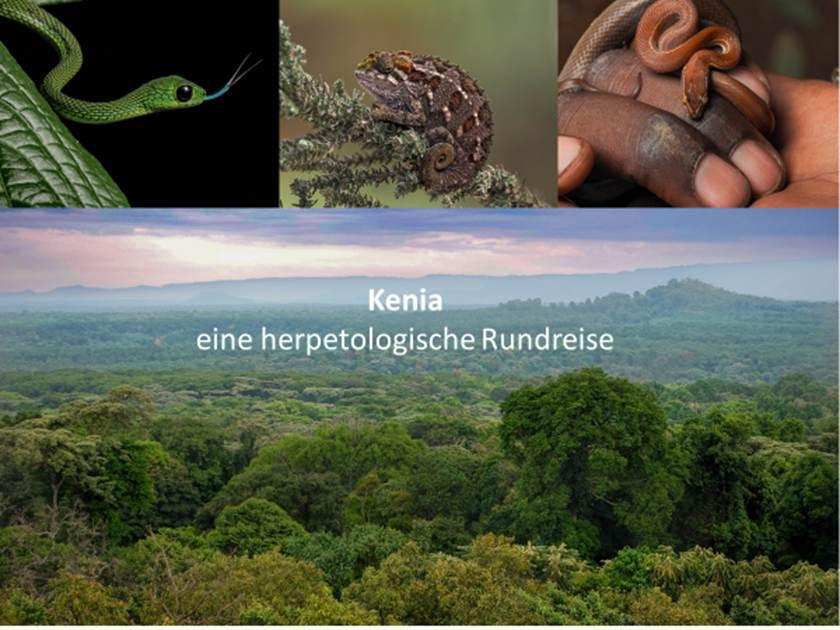
On Friday, 6 February 2026, Rolf Mätzkow will give a richly illustrated lecture about an exciting journey in Kenya. And chameleons will not be neglected!

Kenya attracts visitors not only with its high biodiversity, but also with its diverse landscapes. The short herpetological tour takes viewers via Naivasha to the Kakamega Rainforest, Kenya’s only tropical (lowland) rainforest. Further along the route, the chameleon-rich heights of Njoro invite you to stop off before the journey continues to Mount Kenya National Park – and not just for the chameleons. Of course, the savannah landscape is a must on this tour, and so Tsavo National Park, with its snakes, lizards and tortoises, fits seamlessly into our tour concept. A visit to the coastal landscape of Watamu, where we finally get to see coral skinks, brings this short tour to a harmonious close.

Rolf Mätzkow Kenya – a herpetological round trip [German]
DGHT Stadtgruppe Dortmund
Restaurant Olympia – Zur alten Post
Im alten Dorf 2
59192 Bergkamen
Lecture begins at 7.30 p.m.

Photos: Collage by Rolf Mätzkow accompanying the lecture

Presentation in Munster about Madagascar’s chameleons

Presentation in Munster about Madagascar’s chameleons

Reiseberichte Live lectures Science

The DGHT Münster is also starting the new year with lots of chameleons. On Friday, 16 January 2026, Philip-Sebastian Gehring will give a detailed lecture on Madagascar and its many chameleons.

Madagascar is home to almost half of all known chameleon species worldwide, all of which are found exclusively on this island. This extraordinary diversity makes Madagascar’s chameleons an important subject of scientific research, as they offer unique insights into the mechanisms of evolution and adaptation. Over the past 20 years, numerous studies and new discoveries have significantly expanded our understanding of species diversity and evolutionary processes within this group of reptiles. In particular, the identification and description of new species and the investigation of their genetic differences have provided key insights into the origin and differentiation of species. The lecture will provide a comprehensive overview of this research and clearly present the current state of research on Madagascan chameleons.

Dr. Philip-Sebastian Gehring Evolution and diversity of Madagascar’s chameleons – Latest research findings [German]
DGHT city group Munster
Zoo school of Allwetterzoo Munster
Sentruper Straße 315
48161 Münster
Lecture begins at 7 p.m., doors open at 6:30 p.m. via the main entrance of the zoo.

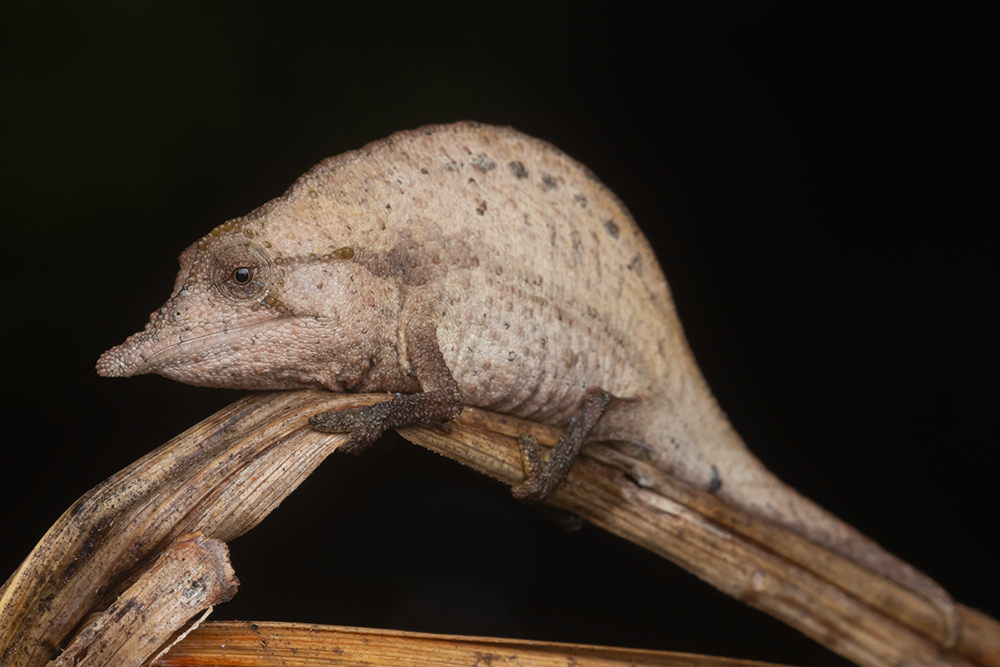
Photos: small Calumma species in Madagascar, photographed by Philip-Sebastian Gehring

Presentation in Frankfurt about Madagascar

Presentation in Frankfurt about Madagascar

Reiseberichte Live lectures Science

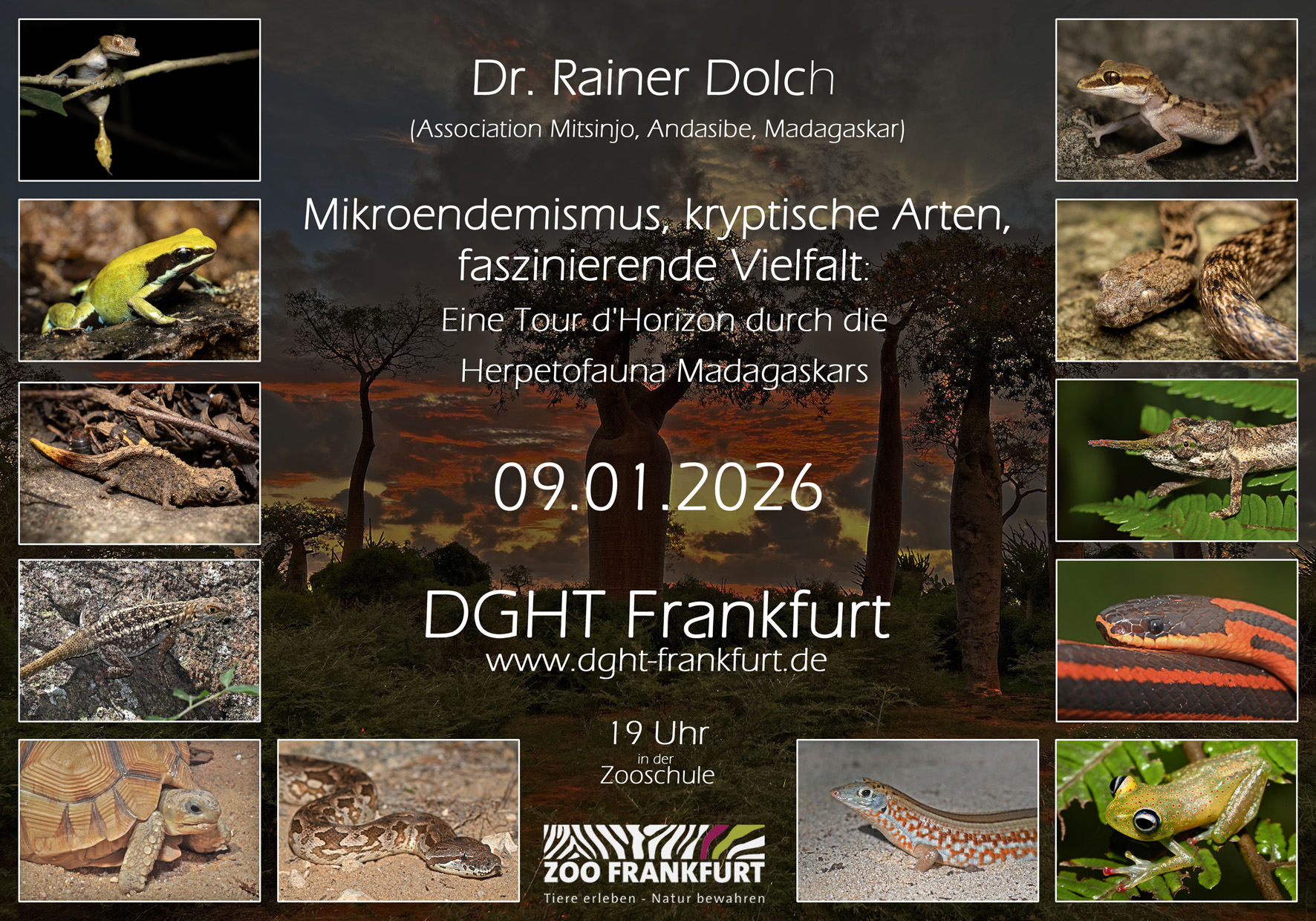
The DGHT Frankfurt is kicking off the new year with a highlight. Thanks to a visit home, they are fortunate to welcome Rainer Dolch from the Association Mitsinjo in Andasibe, Madagascar. On Friday, 9 January 2026, he will give a detailed lecture on Madagascar and its herpetological diversity.

Madagascar’s amphibians and reptiles inhabit a wide variety of habitats, from lowland forests to the highest mountain peaks, karst areas, dry forests and unique semi-deserts. Madagascar’s long isolation after the break-up of the supercontinent Gondwana, its geography and the enormous diversity of its habitats have promoted evolutionary processes that have produced numerous endemic species of amphibians and reptiles. Many of these taxa are allopatric and microendemic, meaning they are restricted to very small, confined areas. Endemic families such as the Madagascar frogs (Mantellidae), the Madagascar snakes (Pseudoxyrhophiidae) and the Madagascar iguanas (Opluridae) have each undergone major radiation. A wide variety of legless skinks and some of the world’s rarest turtles also belong to the island’s extraordinary herpetofauna. Finally, Madagascar is a hotspot for chameleon diversity. In the chameleon genus Calumma in particular, many cryptic species have only recently been described which, although they look almost identical externally, are genetically so different that they can no longer reproduce with each other. Many of the amphibians and reptiles native to Madagascar and the habitats they inhabit are presented, as are the threats they face and measures taken to protect them.

Dr. Rainer Dolch Microendemism, cryptic species, fascinating diversity: a tour d’horizon through the herpetofauna of Madagascar [German]
DGHT city group Frankfurt
Zoo school of Frankfurt zoo
Bernhard-Grzimek-Allee 1
60316 Frankfurt am Main

Lecture begins at 7 p.m., doors open at 6:30 p.m. via the exit gate at the main entrance on Alfred-Brehm-Platz (gate between the zoo shop and the zoo society building).

Photos: Herpetological diversity of Madagascar, photographed by Rainer Dolch

Presentation in Frankfurt about Ethiopia

Presentation in Frankfurt about Ethiopia

Reiseberichte Live lectures Science

On Friday, 26 September 2025, herpetologist Dr Arthur Tiutenko from Friedrich-Alexander University Erlangen-Nuremberg will give a lecture accompanied by numerous images about a very special forest in Ethiopia.

The Harenna Forest, which stretches along the southern slopes of the Bale Mountains in southern Ethiopia, is one of the last remaining forest areas in the Horn of Africa and the largest remaining rainforest on the African mainland. It is not only home to Arabica coffee, but also to numerous other endemic plant and animal species, many of which have not yet been scientifically discovered and described. The herpetofauna of the Harenna Forest includes more than 40 species, including the two large Ethiopian vipers – Bitis harenna and Bitis parviocula. The habitats of these animals and the entire ecosystem are being destroyed by overpopulation and increasing economic exploitation. Even the future of the officially protected parts of the forest looks bleak. This makes it all the more important to gain knowledge about the species that still live in the forest before it is too late. Arthur Tiutenko has explored the Harenna Forest in ten expeditions, the results of which he reports on in this lecture.

Dr. Arthur Tiutenko Harenna Forest, Ethiopia – 12 years of expeditions into the last rainforest in the Horn of Africa [German]
DGHT Stadtgruppe Frankfurt
Zoo school of Zoo Frankfurt
Bernhard-Grzimek-Allee 1
60316 Frankfurt am Main
Lecture begins at 7 p.m., doors open at 6:30 p.m. via the exit gate at the main entrance on Alfred-Brehm-Platz (gate between the zoo shop and the zoo society building).

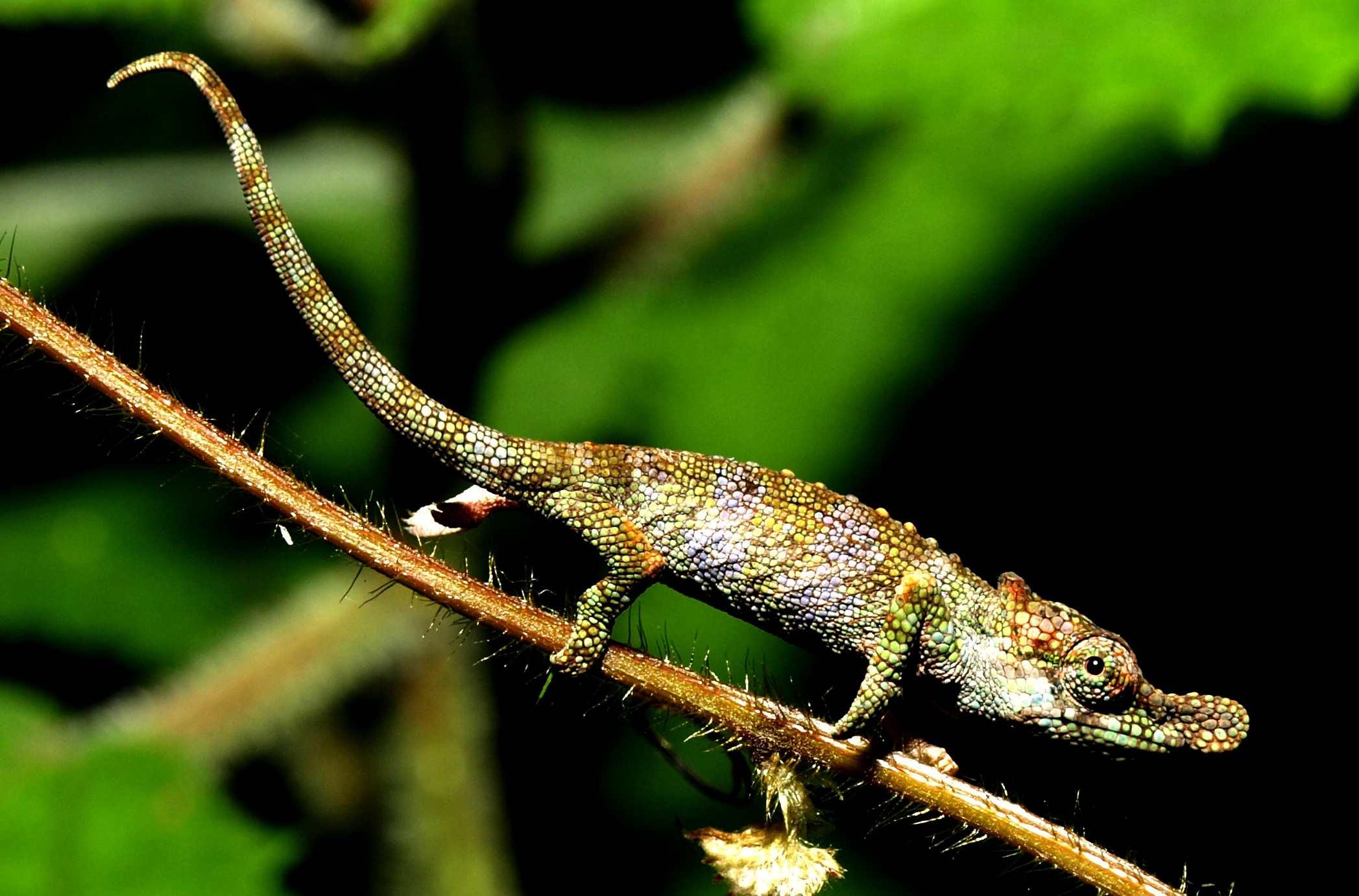
Photo: Trioceros balebicornutus, photographed by Arthur Tiutenko on one of his travels

Presentation in Bavaria about chameleons

Presentation in Bavaria about chameleons

Haltungsberichte Reiseberichte Live lectures

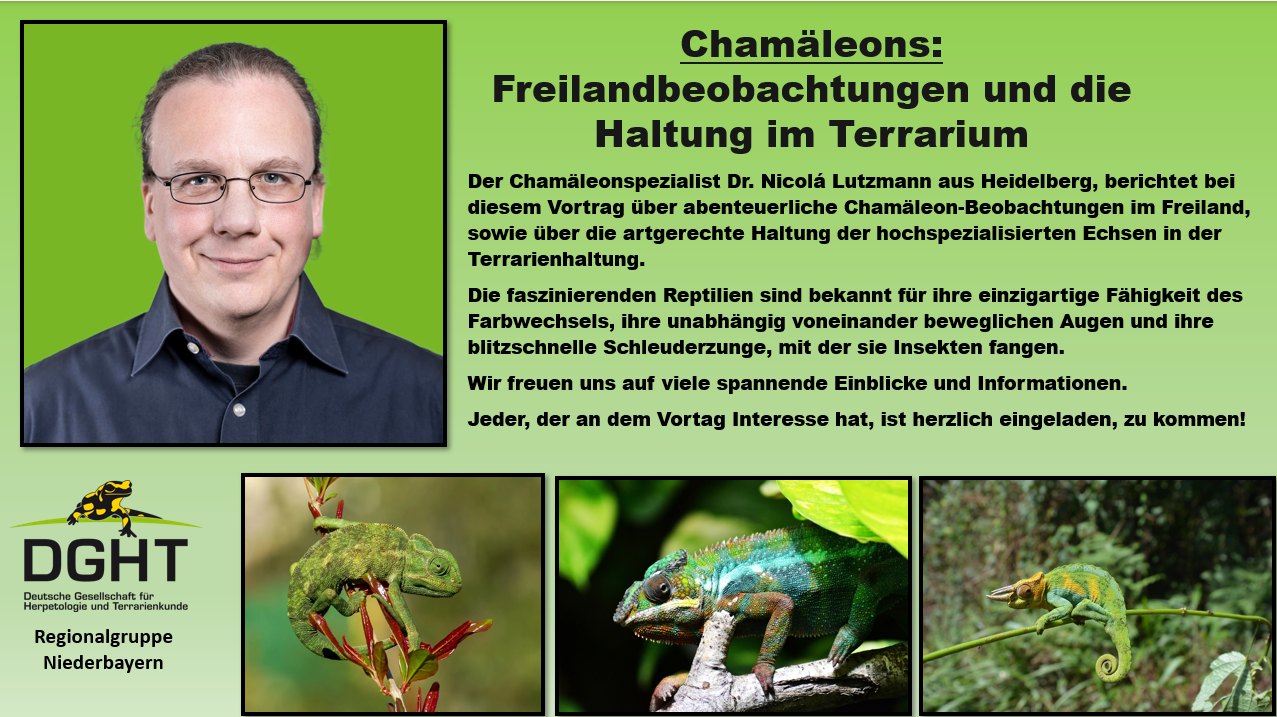
Long-standing AG member Nicolá Lutzmann from Heidelberg will give an interesting lecture on chameleons on Saturday, 20 September 2025. In this lecture, he will report on adventurous chameleon observations in the wild, as well as on the species-appropriate keeping of these highly specialised lizards in terrariums. These fascinating reptiles are known for their unique ability to change colour, their independently movable eyes and their lightning-fast forked tongue, which they use to catch insects.

Dr. Nicolá Lutzmann Chameleons: Outdoor observations and keeping them in a terrarium [German]
DGHT regional group lower Bavaria
Restaurant Aurora
Klausenweg 15
84152 Mengkofen
Lecture begins at 8 p.m., dinner together from 6.30 p.m.

Presentation in Leipzig about Madagascar

Presentation in Leipzig about Madagascar

Reiseberichte Live lectures

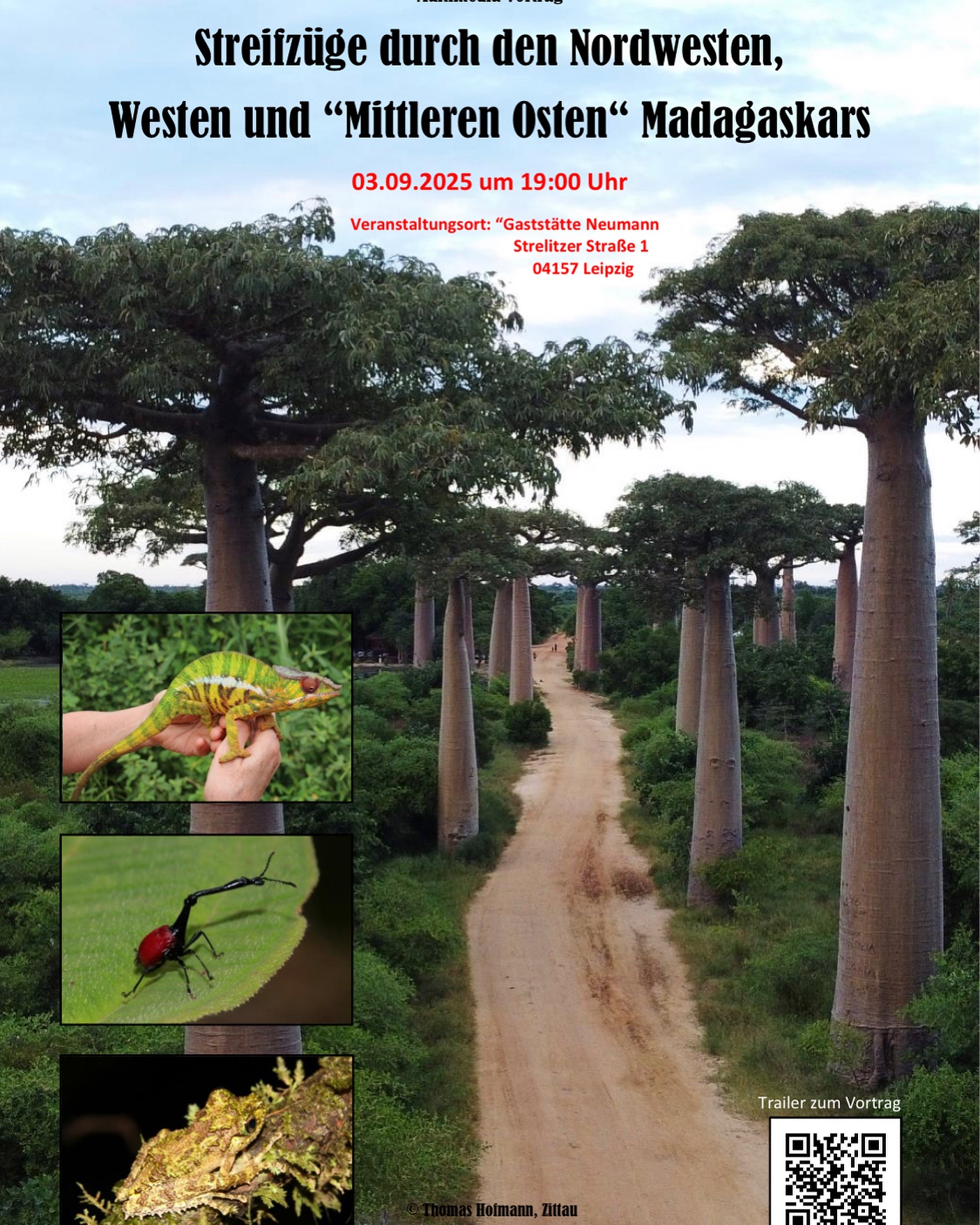
On Wednesday, 3 September 2025, Thomas Hofmann will give a lecture rich in images about Madagascar in Leipzig (Saxony). The island in the Indian Ocean is a mecca for travellers interested in herpetology. Over 90% of the reptiles and amphibians found here are endemic – they exist nowhere else in the world. Among the endemic species are not only a large number of chameleons, but also many other herpetological highlights.

Thomas Hofmann Excursions through the north-west, west and ‘Middle East’ of Madagascar [German]
DGHT Stadtgruppe Leipzig
Restaurant Neumann
Strelitzer Straße 1
04157 Leipzig
Start of the event 7 p.m.

Presentation in Hamburg about Madagascar’s chameleons

Presentation in Hamburg about Madagascar’s chameleons

Reiseberichte Live lectures

Lars Dwinger, member of the Chameleon Working Group, will give a detailed presentation on his trip to Madagascar this year on Saturday, 6 September 2025.

Together with the Tanalahorizon team and herpetologist Dr. Frank Glaw, he set off for north-eastern Madagascar. The team spent a whole week in the mountain rainforest of Marojejy to find, document and – thanks to permits – also collect undescribed chameleon species. A fantastic experience with numerous unexpected highlights! Following this sweat-inducing but, as far as chameleons are concerned, very successful expedition, the team headed to the lowland rainforest of Bobangira, right on the Indian Ocean. This part of the island is practically unexplored due to its poor accessibility – as the lecture clearly illustrates – and is home to a large number of snakes and other undescribed chameleons. But it’s not just chameleon lovers who will get their money’s worth at this lecture; other reptiles and amphibians are also shown in numerous fantastic photos.

Lars Dwinger The summit of Marojejy and the gallery forest of Bobangira – two virtually unexplored herping paradises [German]
50th Jubilee and VDA regional day
Ganztagszentrum
Am Markt 2
22941 Bargteheide
Presentation begins at 2 p.m.

Picture: Palleon lolontany, photographed by Markus Bartels on this very trip

Presentation in Basel about the Comoros

Presentation in Basel about the Comoros

Reiseberichte Live lectures

Dr Oliver Hawlitschek from the University of Zurich will be giving a great lecture on the Comoros on Wednesday, 5 March 2025 in Basel (Switzerland). The Comoros are a group of four volcanic islands in the Western Indian Ocean. Compared to similar oceanic archipelagos such as Hawai’i and the Galápagos, however, they are little known globally and little scientifically researched. The fauna is characterised by a large number of endemic species. Over the past 15 years, Oliver has studied the taxonomy, biogeography and ecology of the reptiles and amphibians living there and has been involved in numerous conservation projects. He will be presenting the results of this work on this evening – it’s sure to be very exciting!

Dr. Oliver Hawlitschek The Comoros, a hotspot of herpetological diversity in the Indian Ocean [German]
DGHT city group Basel
Restaurant Schiff
Baslerstraße 32
4102 Binningen
Vortragsbeginn 20.00 Uhr

Presentation in Hamburg about Madagascar’s chameleons

Presentation in Hamburg about Madagascar’s chameleons

Reiseberichte Live lectures

If that’s not an exciting and highly interesting start to the new lecture year! On Friday 10 January 2025, Falk Eckhardt, a long-standing member of the Chameleons Working Group, will be giving a detailed talk on the chameleons of Madagascar.

Hardly any other lizard family is as well known as the chameleons. This is mainly due to their many special features, such as their independently movable eyes, rapid colour change, sling tongue, pincer-like feet and prehensile tail. Madagascar is considered the centre of species diversity in this family. Almost half of all chameleon species, including the world’s smallest and largest species, live on this island. There are currently around 100 species on Madagascar, divided into four genera. Representatives of the two original genera Brookesia and Palleon are predominantly small, brownish in colour and usually stay close to the ground. Their ability to change colour is limited and their tail is rather short. The two other genera Calumma and Furcifer, on the other hand, show all the classic characteristics of the ‘typical’ chameleon.

In his lecture, Falk will discuss the distribution and lifestyle of Madagascan chameleons. Special attention will also be paid to the short lifespan of some species, which Falk has also worked with professionally over a longer period of time. The importance of chameleons in Malagasy culture will also be discussed. That really sounds like a wonderful chameleon evening!

Falk Eckhardt Madagascar’s chameleons [German]
DGHT regional group Hamburg
Clubhouse “Am Sportplatzring”
Sportplatzring 47
22527 Hamburg
Presentation starts at 8.00 p.m.

Picture: Furcifer labordi female, photographed by the presenter