Partner wanted

Partner wanted

Internationaler Chamäleontag

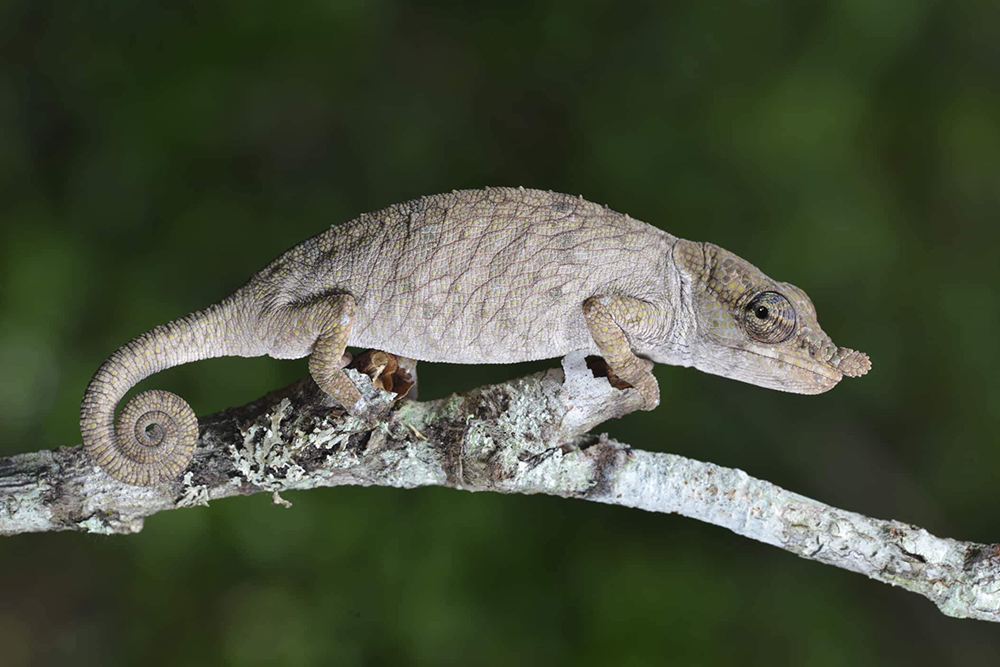
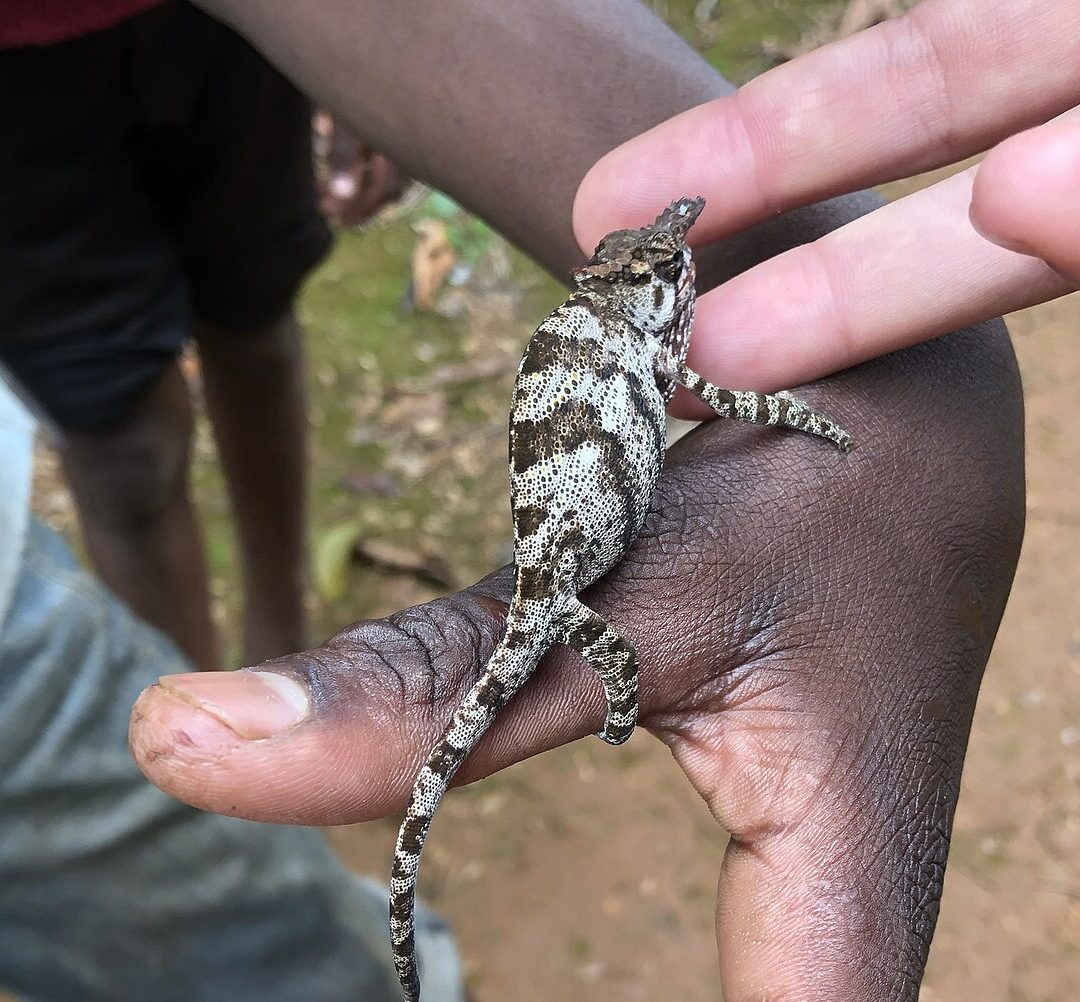
Even today, there are still species of chameleons for which an incredible amount of data is missing. For example, what the male or female of the species even looks like or whether there is a partner animal. Two examples of this lack of data are Calumma juliae and Furcifer monoceras.

Calumma juliae was only discovered in 2018. The species lives in a tiny forest remnant near Moramanga, a town in the eastern highlands of Madagascar. Despite an intensive search, no male of the species could be found. This raises the question of whether the species – which would be extremely unusual for chameleons – could possibly be capable of parthenogenesis (producing young). If so, these chameleons would not need males at all. However, this is not particularly likely.

In our second example, it is the other way round. Furcifer monoceras was last seen many, many years ago – namely before its description, in 1905 – near the coastal town of Mahajanga. However, only the male had been discovered, which is also hard to confuse due to its conspicuous, huge nose. The female, on the other hand, is unknown. To date, the species has not been found again and is considered lost. Initial efforts to find the species have unfortunately been unsuccessful. Many dry forests around Mahajanga no longer exist, so it could just as well be that the habitat of Furcifer monoceras has long since disappeared. With or without the chameleon, that is the big question. So it remains exciting!

#showyourcolours #internationalchameleonday #chameleonday #chameleondayMay9 #agchamaeleons

Photo: Calumma juliae female, photographed by Thorsten Negro

Longer in the egg than alive

Longer in the egg than alive

Internationaler Chamäleontag

A chameleon that’s been in the egg longer than it’s been alive? It does exist! Of course, not every Labord’s chameleon (Furcifer labordi) is like this. But this is probably the shortest-lived chameleon in the world. They live in western Madagascar, where it is very hot and dry most of the year. During the short, intense rainy season, the chameleons hatch, grow to adulthood at record speed, mate immediately and lay eggs quickly before most of them die in the same season. The average Labord’s chameleon therefore only lives for three to five months! In contrast, the eggs lie in the ground for between eight and ten months until the next rainy season. Depending on how a rainy season turns out in western Madagascar, the Labord’s chameleon’s entire population may only exist in eggs in the worst-case scenario. A fascinating, but also somewhat creepy idea.

#showyourcolours #internationalchameleonday #chameleonday #chameleondayMay9 #agchamaeleons

Picture: Furcifer labordi male, photographed by Lennart Hudel, Creative Commons Attribution 4.0 International

Lost for more than 100 years

Lost for more than 100 years

Internationaler Chamäleontag

Did you know that there is a chameleon that was considered lost for over 100 years? Voeltzkow’s chameleon (Furcifer voeltzkowi) was last seen in 1913. Since then, it was considered lost because neither the exact location where it was found nor what the females looked like was known. In fact, the species lived completely undisturbed in western Madagascar on a peninsula directly opposite the large coastal town of Mahajanga. Until 2018, when a German-Madagascan research team set out to rediscover the long-lost species. They succeeded – in a hotel garden! The main reason why the species had not been observed for so long is probably due to the poor accessibility of the peninsula on which they live and the short lifespan of the animals. It is assumed that, like Furcifer labordi, a closely related species, they only live for a few months. They can therefore only be found at a certain time of year.

#showyourcolours #internationalchameleonday #chameleonday #chameleondayMay9 #agchamaeleons

Photos: Furcifer voeltzkowi, male and female, photographed by Alex Laube

Colouring chameleons

Colouring chameleons

Internationaler Chamäleontag

Time to colour! We’ve put together lots of colouring pictures that all kinds of websites have to offer for free. Just click on them and you’ll be redirected to the website offering them. Then print them out and off you go! Grab your coloured pencils, felt-tip pens or whatever else you use and get colouring! Incidentally, the colouring pictures are not just for children – there are also suitable, slightly more difficult templates for adults. A little time out on a holiday is certainly not a bad idea.

#show your colours #internationalchameleonday #chameleonday #chameleondayMay9 #agchamaeleons


Show your tongue!

Internationaler Chamäleontag

The tongue of chameleons is something very special: chameleons use it to catch their food in a spectacular way by shooting with it. For a long time, it was thought that one of the tongue muscles was responsible for the shooting power. Today we know that an apparatus consisting of many layers of collagen fibres provides the necessary shooting ability. Put simply, the chameleon tongue works like a kind of catapult with a rubber band, only in milliseconds. The structure of the tongue is explained in more detail here.

The chameleon’s tongue shoots out of its mouth with incredible acceleration, hits the food and is then slowly retracted again. The chameleon closes its eyes to prevent injury to these valuable sensory organs when the tongue and insect retract. When fully “extended”, the tongue of most chameleons is one and a half times as long as the body, and in very small species such as ground chameleons it can be up to two and a half times as long. A truly remarkable organ!


#showyourcolours #internationalchameleonday #chameleonday #chameleondayMay9 #agchamaeleons

Video: Madcham.de

Chameleon DAY? Chameleon WEEKEND!

Chameleon DAY? Chameleon WEEKEND!

AG Interna Internationaler Chamäleontag

And for those who have acquired a taste for chameleons and can’t get enough of them: There is not only an International Chameleon Day this year, but also a whole weekend dedicated to chameleons! Our 2024 conference is the right place for you. From 24 to 26 May 2024, chameleon friends from all over the world will meet in Fulda, Germany, to exchange experiences, learn tips and tricks and pursue their shared hobby, the world of chameleons. We have prepared a colourful series of lectures and a photo competition. Anyone who is interested can register without obligation via our website. We look forward to seeing “old friends”, but also new faces!

#showyourcolours #internationalchameleonday #chameleonday #chameleondayMay9 #agchamaeleons #chameleonweekend #chameleonconference

Can you keep chameleons as a pet?

Can you keep chameleons as a pet?

Internationaler Chamäleontag

For many, many years, chameleons were considered “untenable”. While dogs and cats have accompanied humans for centuries, supposedly more “exotic” species were only later discovered as potential pets. However, due to their not entirely low husbandry requirements, chameleons were always somewhat marginalised for decades. It wasn’t until the 1990s that more and more keepers were able to successfully keep and breed different species of chameleons thanks to major developments in terrarium technology. Today, there are even several species that can be recommended with a clear conscience even to beginners in the herpetoculture hobby. So a lot has happened in the hobby. A few decades ago, chameleons or individual species were still considered “untenable”, but today we have a large number of positive husbandry reports on a wide variety of species from all over the world. The magazine of the AG Chameleons, CHAMAELEO, has been publishing such husbandry reports for many years. Sorted by species, you can find over a hundred of them here: Overview of husbandry reports.

#show your colours #internationalchameleonday #chameleonday #chameleondayMay9 #agchamaeleons

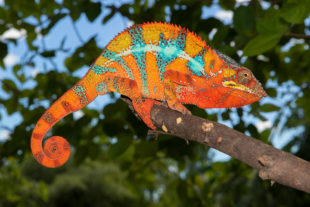
Picture: Panther chameleon, one of the most commonly kept species in herpetoculture, photographed by Bernard Dupont, Creative Commons Attribution-Share Alike 2.0 Generic

Tail comparison

Tail comparison

Internationaler Chamäleontag

Chameleons have a unique, movable tail. It is an extension of the spine and can be completely curled up to make the chameleon appear larger. The animals make use of this, for example, when they threaten conspecifics. Due to the shape of the vertebrae, the tail can only be curled downwards – even if Disney somehow didn’t realise this. Tree-dwelling chameleons usually have a tail that is about as long as their body. One exception is Furcifer balteatus, which has proportionally the longest tail. Tree-dwelling chameleons use their tails for gripping when climbing and can easily hang their entire body weight from them. Ground-dwelling chameleons usually only have a short stumpy tail, which is only placed on the ground for stabilisation when walking.

#show your colours #internationalchameleonday #chameleonday #chameleondayMay9 #agchamaeleons

Photo: Tail of a Parson’s chameleon, photographed by Alex Laube

The panoramic view

The panoramic view

Internationaler Chamäleontag

Chameleons are known for being able to move their eyes independently of each other. They protrude far from the skull and are completely covered with scaly eyelid skin except for a narrow iris and the pupil. This anatomical peculiarity gives chameleons the effect of a pinhole camera in both eyes, allowing them to see much more clearly. Chameleons can see up to one kilometre (!) away. The focusing speed is around 60 dioptres per second – four times what a human is capable of. Chameleons mainly see colours and little contrast, which makes them practically blind at night. Small oil droplets that accumulate on the cones also provide chameleons with a kind of “built-in sunglasses”. But chameleon eyes can do much more! The chameleon has an incredibly large field of vision of 90° vertically and 180° horizontally. The total field of vision is a fantastic 342°! Only over the back directly behind the head is there a blind spot of 18°, in which a chameleon can see nothing. By comparison, humans only have a paltry 189° field of vision. Chameleons also have very special lenses. The chameleon’s range of accommodation is an incredible 45 dioptres. Humans can accommodate just 15 dioptres when they are young, and even less when they are older. However, it is not known whether the chameleon’s visual acuity decreases with age.

#show your colours #internationalchameleonday #chameleonday #chameleondayMay9 #agchamaeleons

Foto: Auge eines Pantherchamäleons, fotografiert von Brice Miller, Creative Commons Attribution-Share Alike 4.0 International

The hands and feet of chameleons

The hands and feet of chameleons

Internationaler Chamäleontag

Chameleons can move perfectly on thin and thick branches. Their modified hands and feet enable them to do this. The bones of both hands and feet are very similar to those of humans. The only difference is that they are divided into small grasping pincers so that the chameleon can hold on to branches better. This makes climbing much easier for them than for us! On the hands, two fingers point outwards and three inwards. On the feet it is the other way round. This situation of “grown together” fingers is called syndactyly. There is a small, pointed claw on each finger and each toe. These claws enable the females to dig effectively so that they can later lay their eggs. This is why the claws of some species become longer than usual during the breeding season.

#show your colours #internationalchameleonday #chameleonday #chameleondayMay9 #agchamaeleons

Abbildung: aus The Osteology of Reptiles, 1925
Foto: Chamaeleo zeylanicus, fotografiert von Hari K Patibanda, Creative Commons Attribution 2.0 Generic